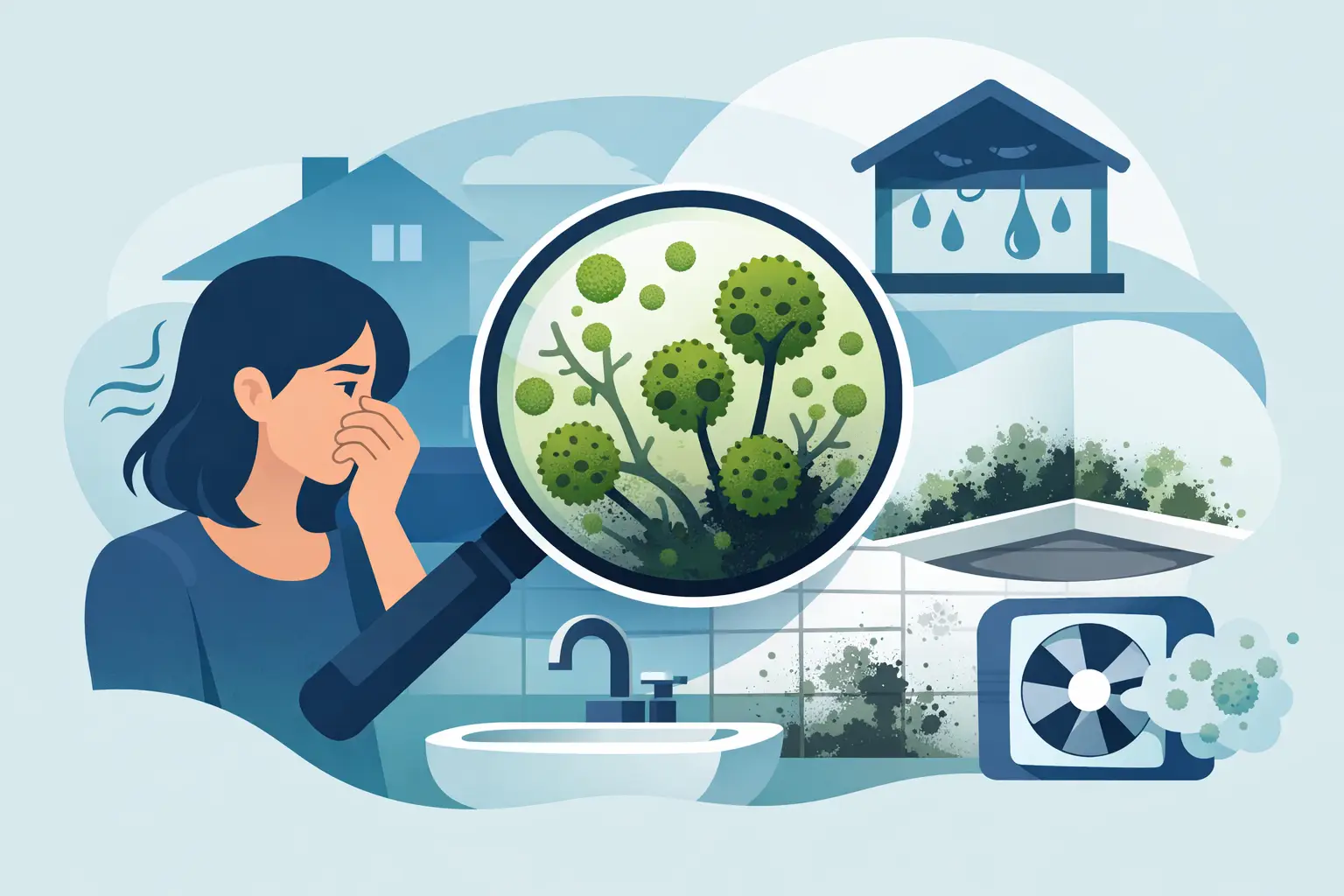
A faint musty odor after a Texas rainstorm, a ceiling stain that seems dry, or paint that begins to bubble near a window can all be mold warning signs. None automatically proves that a property has a mold problem, but each can point to the same underlying issue: moisture is present where it should not be. Mold requires moisture to grow, so the most useful question is often not simply, “Is this mold?” but “Where is the water coming from, and how long has it been there?”
A careful evaluation looks beyond what is visible. It considers the building, the moisture source, the materials affected, and the conditions that could allow hidden growth to develop. That approach helps homeowners, property managers, contractors, and insurance professionals make decisions based on evidence rather than assumptions.
Mold Warning Signs Inside a Property
Visible discoloration is the sign most people notice first. Mold growth may appear black, green, gray, brown, white, or orange, but color alone cannot identify the type of growth or determine its significance. It can look fuzzy, speckled, powdery, or like a stain embedded in drywall, wood, caulk, carpet backing, or insulation.
Not every dark mark is mold. Dirt, soot, water staining, old adhesive, and ordinary surface discoloration can look similar. Conversely, mold may be present behind a wall or beneath flooring with little or no visible evidence. That is why a visual observation should be evaluated alongside moisture conditions and the history of the area.
A persistent musty or earthy odor is another common concern. Odors can be especially noticeable when a home has been closed up, when the air conditioning first runs, or after humidity rises. A musty smell does not identify a specific mold species, and it does not tell you how much growth may be present. It does, however, justify investigating for damp building materials, plumbing leaks, HVAC condensation, or other moisture sources.
Water damage is often the clearest early indicator. Watch for stains on ceilings or walls, warped baseboards, peeling paint, swollen cabinetry, buckled flooring, loose wallpaper, or soft drywall. Even if a leak has been repaired, materials may have remained wet long enough to support mold growth. The visible stain may also be some distance from the active leak, since water can travel along framing, piping, or ceiling assemblies before becoming apparent.
Condensation deserves attention as well. Repeated moisture on windows, supply vents, metal ductwork, cold water lines, or exterior-facing surfaces can signal elevated indoor humidity, inadequate insulation, air leakage, or an HVAC issue. A single instance of condensation during unusual weather may not be a major concern. Condensation that returns regularly is different because recurring dampness can affect nearby materials over time.
Changes That Suggest a Hidden Moisture Problem
Some of the most meaningful mold warning signs are changes in the building rather than visible growth. A room that feels unusually humid, a closet with a stale odor, or a section of flooring that becomes soft or uneven can indicate moisture trapped below the surface.
Pay particular attention after a known water event. Roof leaks, plumbing failures, overflowing fixtures, appliance leaks, window intrusion, foundation moisture, and storm-related damage can all create conditions for mold growth. In Texas, high outdoor humidity and heavy rain events can add another layer of risk, especially where drainage, flashing, window installation, or air conditioning performance is deficient.
HVAC systems also warrant a careful look. A system that does not dehumidify effectively can leave indoor humidity higher than desired. Condensate drain problems, wet insulation near equipment, duct leakage, or poorly insulated components can create localized moisture conditions. A musty odor that appears when the system operates should be investigated, but it should not be assumed that the duct system itself is the source without an assessment.
In commercial properties and multifamily buildings, reports from more than one occupant can be useful. Repeated concerns in the same stack of units, around a particular roof area, or near common plumbing lines may reveal a building-wide pattern. Property managers benefit from documenting dates, locations, water events, photographs, repair records, and occupant observations before conditions change.
When Visible Mold Is Not the Whole Story
Mold can grow behind drywall, under flooring, inside wall cavities, above ceilings, and within other concealed areas when a moisture source reaches susceptible materials. A wall may look normal while moisture readings, thermal imaging patterns, or material damage indicate a reason for further evaluation.
Thermal imaging can help identify temperature differences that may be consistent with moisture or air leakage. It is a useful screening tool, not a stand-alone diagnosis. A cooler area on an infrared image can result from many conditions, including insulation differences or air movement. Moisture mapping with appropriate meters, combined with a visual inspection and building history, helps determine whether the pattern requires further investigation.
Small visible areas should not be dismissed simply because they appear minor. The right response depends on the location, the material affected, whether moisture is active, and what may be concealed behind the surface. Growth on a bathroom caulk line may be a routine cleaning and ventilation issue. Similar-looking growth around a window with soft drywall, elevated moisture, and recurrent staining may point to a more extensive building-envelope problem.
What Mold Testing Can and Cannot Tell You
Professional mold testing can be valuable when it is tied to a clear assessment question. Air or surface samples may help document conditions, compare indoor areas, support a remediation scope, evaluate an area of concern, or provide laboratory-supported information when visible evidence is limited.
Testing is not a substitute for identifying the moisture source. Mold spores are naturally present in outdoor and indoor environments, and a laboratory result must be interpreted in context. A low or typical air sample result does not rule out hidden growth in every situation, particularly if the affected area is sealed, intermittent, or not actively releasing spores at the time of sampling.
Likewise, a surface sample can identify material collected from one location, but it does not define the full extent of a condition behind a wall or beneath a floor. An independent assessment uses sampling when appropriate, rather than treating it as the only answer. The goal is to understand the property condition well enough to make practical, defensible recommendations.
When to Request an Independent Mold Assessment
An independent assessment is especially helpful when there is visible growth, a recurring odor, unexplained water damage, a recent leak, or concern that prior repairs did not address the cause. It can also be appropriate before a real estate transaction, during a renovation or demolition project, after storm damage, or when an insurance claim requires clear documentation.
For contractors and restoration professionals, an independent assessment can establish a defined remediation protocol before work begins. This helps clarify affected areas, containment expectations, material removal decisions, and post-work objectives. For property owners, it separates the evaluation from the repair work, reducing the pressure to accept a remediation scope that has not been independently supported.
Hurtler Environmental does not perform mold remediation. That independence allows its assessments, moisture investigation, laboratory-supported sampling, remediation protocols, and post-remediation verification to remain focused on the documented conditions of the property.
Do Not Skip the Moisture Source
Cleaning a visible patch without correcting the moisture source often leads to repeat problems. A successful response may involve plumbing repair, roof or window correction, drainage improvements, HVAC adjustments, removal of damaged materials, or changes that reduce indoor humidity. The appropriate scope depends on the cause and extent of the condition.
After remediation, post-remediation verification can provide an independent evaluation of whether the work area has been addressed according to the remediation plan and whether the conditions observed support project completion. It is not merely a visual glance at a cleaned surface. A proper evaluation considers the work performed, remaining moisture concerns, cleanliness, and any sampling that is appropriate for the project.
If you notice a mold-related concern, document what you see and smell, note any known water event, and avoid covering the area with paint or new finishes before the moisture issue is understood. Clear facts at the beginning of the process make it easier to protect the property, coordinate qualified repairs, and move forward with confidence.